
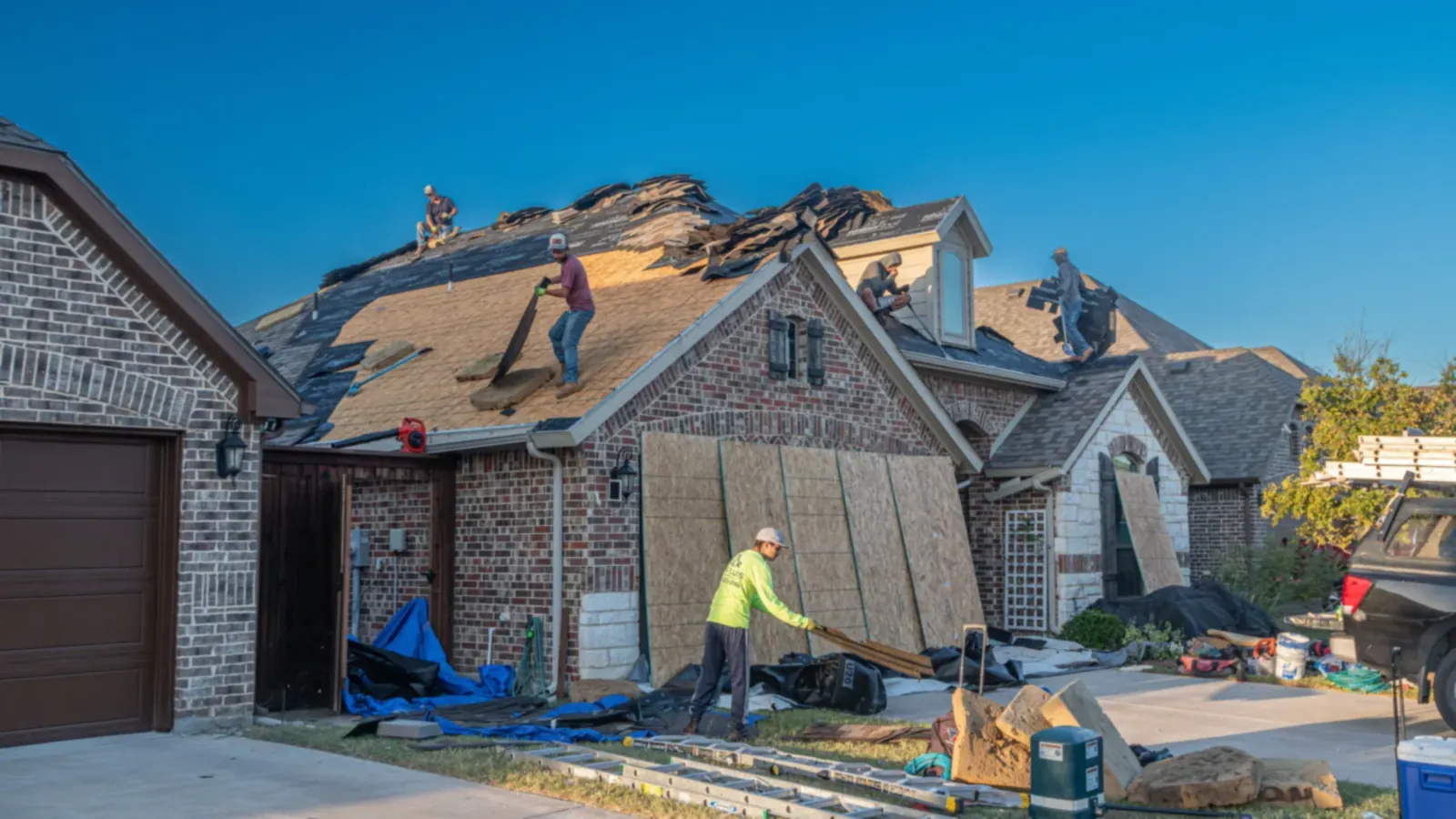
Roof Replacement in Houston & Galveston County
A roof replacement takes the old roof off down to the wood, fixes the wood, and builds a new roof from the decking up: underlayment, drip edge, flashing, vents and the new roof covering. We measure the roof and check the decking before we write a word of the estimate, so the scope you sign is the scope we build.
- Free on-site roof measurement
- Written estimate before tear-off
- Shingle, metal and low-slope roofs
- Homes and businesses
When does a roof need to be replaced instead of repaired?
A roof needs replacing when the problems are spread across whole slopes rather than sitting in one spot. One cracked pipe boot is a repair. Shingles that crack when you bend them, granules collecting in the gutters from every downspout, curled tabs on the south and west faces, and soft decking in several places are signs the covering itself has reached the end of its life.
Age is a clue, not a verdict. Two roofs of the same age on the same street can be in very different shape depending on attic ventilation, tree cover and how the original crew nailed the shingles. That is why our estimate starts with a look at the actual roof and the attic under it.
| What we see | What it usually means |
|---|---|
| One leak, the rest of the roof flat and flexible | A repair, not a replacement |
| Granule loss and curling on every sunny slope | The covering is worn out |
| Patches on top of patches, two layers already | Tear-off and start over |
| Hail bruises or wind creases across many shingles | Often a storm replacement, see storm and hail damage |
| Daylight through the decking, sagging between rafters | Decking and possibly framing work first |
What goes into a new roof, from the decking up?
Every layer has one job, and a new roof fails early when one of them is skipped. The shingles or metal panels are the last thing installed, and they depend on everything below them.
- Decking. Plywood or OSB nailed to the rafters. Soft, delaminated or rotted sheets are cut out and replaced so the new roof has something solid to hold.
- Drip edge. Metal along the eaves and rakes that carries water past the fascia and keeps wind from lifting the first course.
- Underlayment. A synthetic sheet over the whole deck, with a self-adhered membrane in valleys and around chimneys, skylights and pipes.
- Flashing. New step flashing where the roof meets a wall, new counter-flashing at chimneys, new boots on every pipe. Old flashing is not reused.
- Starter and field. A starter strip at every eave and rake, then the field shingles or metal panels fastened to the maker's pattern.
- Ventilation and ridge. Ridge vent or box vents matched to the soffit intake, then the ridge cap.
On homes inside TDI's coastal designated catastrophe area, which takes in Galveston Island, League City, Dickinson and Texas City, the fastening and edge details also have to satisfy the windstorm code. TDI's rules adopt the 2024 International Residential Code for work begun on or after April 1, 2026; the wind requirement depends on the address and the building's risk category, and the TDI-appointed inspector confirms it. If TWIA writes the policy, the inspection application goes in before tear-off.
What happens on the day the old roof comes off?
A typical house is stripped and dried in section by section, so it is never open to the sky overnight.
Tarps over landscaping, a dumpster or trailer placed where it will not crack the driveway
One slope stripped to the wood at a time, the debris dropped straight into the trailer
Decking walked and probed, bad sheets photographed and replaced
Underlayment and membrane laid the same day, so the slope is dry before the crew moves on
Flashing, vents and the new covering installed, ridge cap last
Gutters cleared of debris and the yard swept with a magnet for nails
Do you install roofs on new additions, garages and outbuildings?
Yes. A roof on new framing is a roof replacement without the tear-off, and we build it the same way: decking checked for proper spacing and nailing, full underlayment, flashing at every wall, and a covering chosen to match or complement the main house. For a detached garage, a workshop or a barn, metal is often the practical choice; our metal roofing page compares the systems.
The tricky part of an addition is the tie-in, where the new roof meets the old one or runs into an existing wall. That joint needs new step flashing woven into both roofs and a cricket where water would otherwise pond. We look at it first, because a perfect new roof that leaks at the seam is still a leak.
Shingle or metal for a replacement roof?
Most Houston-area homes are re-roofed in architectural asphalt shingles, and impact-rated shingles are a common upgrade where hail is a worry. Metal costs more up front and lasts longer, sheds heat better and resists wind well when fastened correctly. The shingle roofing page explains the shingle grades, and the roof replacement cost guide explains how each choice moves the estimate.
Many neighborhoods with homeowners associations limit roof colors or materials, especially in master-planned areas around Pearland and League City. Check before you fall in love with a color, and we can provide the product sheet the HOA asks for. If only one leak is bothering you and the rest of the roof is sound, our sister company Texas Precision Roofers handles repairs.
Roof replacement questions
What is included in a full roof replacement?
Tear-off of every existing layer, a decking check with bad boards replaced, new drip edge, synthetic underlayment, ice-and-water membrane in valleys and around penetrations, new step and wall flashing, new pipe boots and vents, starter strips, the new roof covering, ridge cap, and a magnet sweep of the yard. Each of those appears as a line on our written estimate.
Can you replace just one side of my roof?
Sometimes, when only one slope was damaged and the rest is sound. The catch is matching: shingle colors change between production runs and older lines get discontinued, so a new slope next to a weathered one often looks patched. When a full match is unlikely, we show you samples and let you decide before anything is ordered.
What happens if you find rotten decking during the tear-off?
We replace it before anything new goes down. Our estimate carries a decking allowance written in sheets, based on what we saw from the attic, and we photograph every board we pull. If the real count comes in higher or lower than the allowance, you see the photos and the adjusted count before the final bill.
Do I need to be home during the replacement?
No, but someone should be reachable by phone. Expect noise and vibration inside, so take pictures and mirrors off walls that share the roof line, and move cars out of the driveway. Attic storage directly under the roof will collect dust and small debris, so cover or move anything valuable stored up there.
Do you put a new roof on a new addition or garage?
Yes. A new roof on fresh framing follows the same build as a replacement without the tear-off: decking inspection, underlayment, flashing where the new roof meets the old walls, and a covering chosen to match or tie into the existing house. We look at how the two roofs join, since that seam is where new additions most often leak.
Will a new roof lower my attic temperature?
It can, mainly through ventilation. When we replace a roof we check the soffit intake and the ridge or box vents and correct an imbalance, which lets hot air leave the attic. A lighter color or a reflective coating on metal also helps. Insulation is a separate job, but the ventilation fix happens with the roof.
Get the new roof planned before the old one comes off
We measure every slope, check the decking and the attic ventilation, and write the estimate before a single shingle is torn off.
Ready to find out what a new roof will take?
The roof measurement is free. We check the decking, count the layers, measure every slope and write the material, underlayment and flashing line by line.