
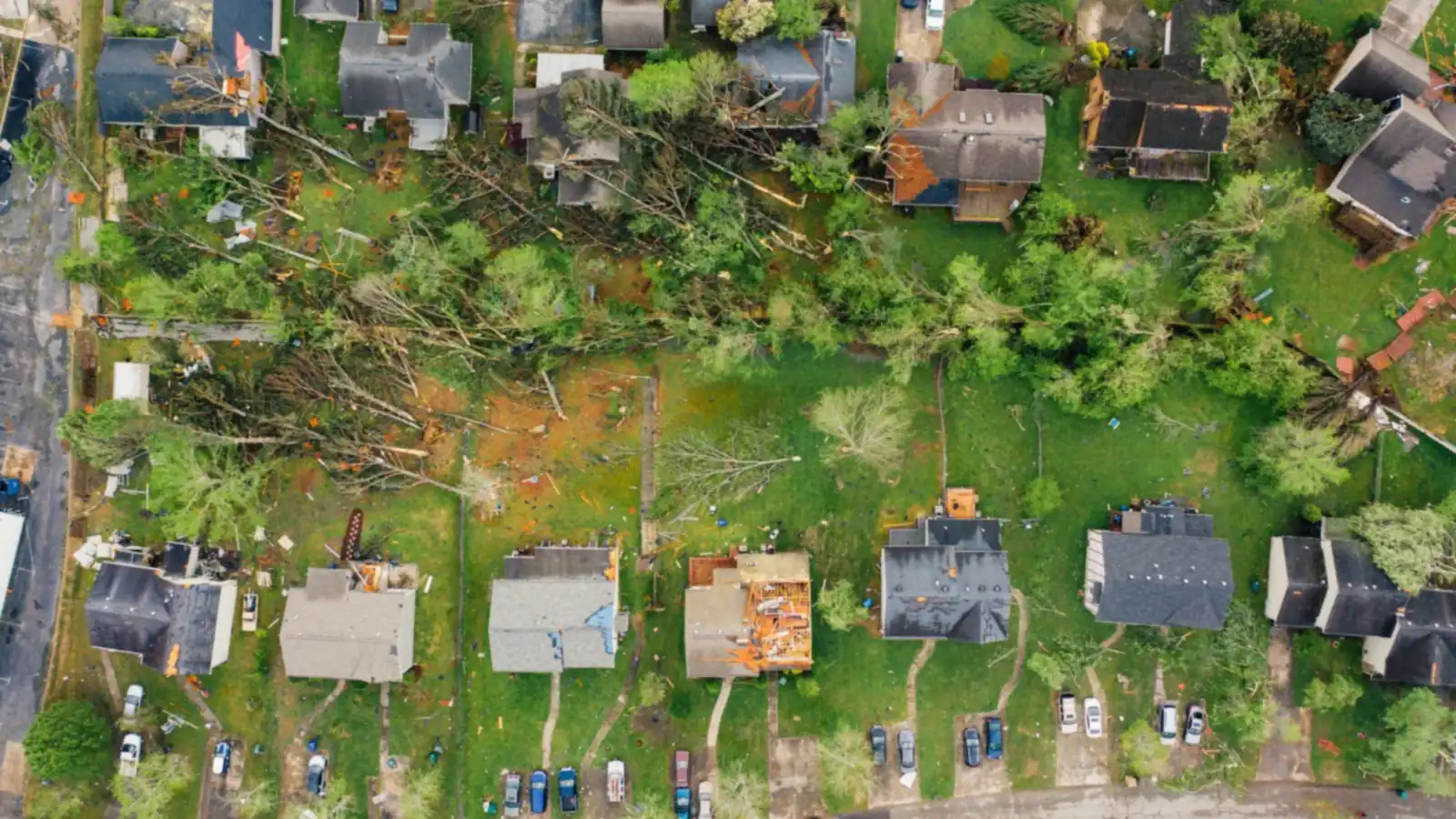
Storm and Hail Damage Roof Replacement
After hail or a hurricane, the question is whether the roof was damaged enough to need replacing and whether the policy will pay for it. We measure and photograph the roof so you and your adjuster are looking at the same facts, and we follow the Texas rules that keep a roof claim legal: you pay your deductible, and the roofer does not adjust your claim.
- Free on-site roof measurement
- Written estimate before tear-off
- Shingle, metal and low-slope roofs
- Homes and businesses
How do you tell storm damage from normal wear?
Storm damage appears suddenly and follows the storm; wear appears gradually and follows the sun. Hail leaves random hits across a slope and dents soft metals like vents and gutters. Wind lifts, creases or removes shingles, usually starting at edges, ridges and corners. Age shows as even granule loss and curling over whole slopes, worst on the south and west faces.
| Sign | Likely cause |
|---|---|
| Random dark bruises, dented vents and gutters | Hail |
| Creased tabs, missing shingles at edges and ridge | Wind |
| Even granule loss, curled tabs on sunny slopes | Age and heat |
| Punctures, broken decking under a limb | Falling tree or debris |
| Blistering in patches | Heat or ventilation, not a storm |
The distinction matters because a policy generally pays for sudden storm damage and generally not for wear. We note which is which on our photos.
Does homeowners insurance cover a roof replacement?
It can, when a covered event like hail or wind damaged the roof badly enough that repair is not reasonable. It generally does not when the roof simply wore out. The specific answer lives in your policy: whether roof coverage is replacement cost or actual cash value, the size of your deductible (often a percentage for wind and hail), and any exclusions for cosmetic damage to metal.
- Replacement cost policies typically pay what it costs to put a comparable new roof on, minus the deductible, sometimes in two payments.
- Actual cash value policies subtract depreciation for the roof's age, so an older roof may receive much less.
- Wind and hail deductibles are frequently a percentage of the dwelling coverage amount rather than a flat amount.
Texas rules, per the Texas Department of Insurance: the policyholder pays the deductible; a contractor may not offer to waive, rebate or absorb it; and a contractor who provides or may provide services on the property may not act as the public adjuster on that claim.
What do we do after a storm hits your roof?
We give you and your adjuster clear facts, and we leave the claim decisions with you and your insurer.
Arrange a tarp if water is getting in, before anything else
Inspect every slope, plus vents, gutters, flashing and the attic
Photograph hail hits, wind creases and missing shingles slope by slope
Measure the roof in squares, pitch, layers and penetrations
Write a replacement estimate you can compare with the adjuster's scope
Meet the adjuster on the roof if you would like us there
How do you spot a storm chaser after hail?
Look at what they promise and where they will be next year. After a large hailstorm, crews from out of state arrive within days, knock on doors and sign contracts fast. Many do adequate work; the problems come when a question or a leak shows up after they have moved on to the next storm.
- An offer to cover your deductible. TDI says that is illegal in Texas.
- A promise to handle your claim. A roofer working on your house cannot act as your public adjuster.
- Pressure to sign today. A written estimate after a measured inspection is normal; a contract on the porch is not.
- No local address or phone. Ask where the company will be if the roof leaks next spring.
Need the fix but not a new roof? Small wind damage on an otherwise sound roof is often a repair, which our sister company Texas Precision Roofers handles.
What changes for hurricane damage near the coast?
Wind coverage and the windstorm inspection. On many homes in Galveston County and along the bay, wind is covered by a separate TWIA policy, and the Texas Department of Insurance requires roof work on TWIA-covered homes inside its designated catastrophe area to be inspected by a TDI-appointed inspector or engineer for a certificate of compliance (WPI-8), with the inspection applied for before the work begins. Galveston Island, League City, Dickinson and Texas City are all inside that area.
The replacement roof is built to the wind requirement the current code sets for the address, which the roof replacement page explains, and impact-rated shingles are worth considering where hail returns; see our impact-resistant shingle guide.
Storm and hail damage questions
What does hail damage look like on a shingle roof?
Soft spots where the granules were knocked off and the mat underneath is exposed or bruised, often dark circles that feel spongy when pressed. Cracked or split shingles and dented metal vents, gutters and flashing are other signs. Damage tends to be heaviest on the slopes facing the direction the storm came from, so we check every slope rather than one.
Can a roofer waive or pay my insurance deductible?
No. The Texas Department of Insurance says it is illegal for a contractor to offer to waive, rebate or absorb a policyholder's deductible, and the policyholder must pay it. An offer to cover your deductible is a warning sign about the company making it, and an insurer can ask you for proof that the deductible was paid.
Will you deal with my insurance company for me?
We provide the roof measurements, photos and our written estimate, and we can meet the adjuster on the roof so the damage is seen in person. Texas law does not let a roofing contractor who works on the property act as your public adjuster or negotiate the claim. You stay in charge of the claim, or you can hire a public adjuster of your own.
How soon after a storm should I have the roof checked?
Soon. Most policies require prompt notice of a loss, and small hail bruises can start leaking after a few more rains. Wind damage is easier to miss: shingles can be lifted and unsealed without coming off. If water is coming in, protect the inside first, then have the roof looked at before you file so you know what you are reporting.
What if the adjuster says there is no damage?
Ask for the adjuster's report and photos in writing and compare them with ours. Sometimes the disagreement is about one slope or about whether bruising counts as damage under your policy wording. Your policy describes the next steps, such as a re-inspection or appraisal. We can share our photos and measurements, but the claim decision stays between you and your insurer.
Does a hurricane roof claim work differently near the coast?
Often, because wind and flood are separate coverages and many coastal homes carry windstorm coverage through TWIA instead of the main homeowners policy. A TWIA-covered roof replacement also needs the TDI windstorm inspection to keep that coverage. Check which carrier handles wind on your home before you file.
Get the new roof planned before the old one comes off
We measure every slope, check the decking and the attic ventilation, and write the estimate before a single shingle is torn off.
Ready to find out what a new roof will take?
The roof measurement is free. We check the decking, count the layers, measure every slope and write the material, underlayment and flashing line by line.